What the EU will soon require from your AI device
If you ship devices in the EU market, two regulations should now be on your road map: the Cyber Resilience Act (CRA) and the AI Act.
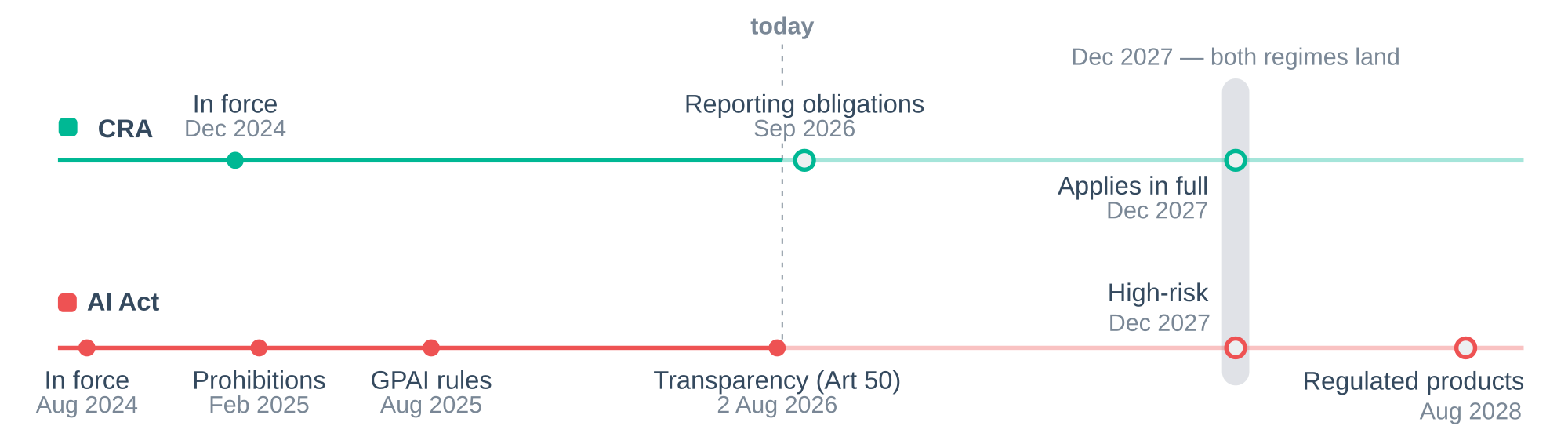
Both are in force, phasing in over the coming years. The CRA’s first hard obligation lands in September 2026, only a few weeks from now.
This post summarizes what each law requires, the dates that matter, and what it means for anyone shipping AI models on hardware. Just a heads-up, we are not a legal company, but this is our overview of the field!
The Cyber Resilience Act
The CRA is simple to explain: if you sell a product with “digital elements” in the EU (hardware or software) that is connected (or connectable), you are now responsible for its cybersecurity, for years, by law.
Manufacturers will have to:
- ship products secure by default,
- provide security updates for a support period of at least five years,
- maintain a software bill of materials (SBOM) and a documented vulnerability-handling process,
- report actively exploited vulnerabilities and severe incidents to the authorities,
- and carry a CE marking that now covers cybersecurity, not just electrical safety.
And fines are heavy: non-compliance can cost up to €15M or 2.5% of worldwide turnover. The CRA is not an AI law, but every edge AI product is a product with digital elements, so it applies to your device independently.
The CRA applies in full from December 2027, but its reporting obligations start a few weeks from now.
From that day, if you become aware of an actively exploited vulnerability in your product or a severe incident, you will need to take action within the time limits: first, an early warning within 24 hours, then a full notification within 72 hours, and finally a final report no later than 14 days after a fix is available.
Finally, the CRA covers products already on the market, not just new launches.
The AI Act
The AI Act regulates AI systems by risk tier.
- Unacceptable-risk practices are banned outright (since February 2025).
- General-purpose model providers have their own obligations (since August 2025).
- And everything else falls into either high-risk, the tier with real engineering obligations, or a light transparency regime.
High-risk covers AI in areas like safety components of regulated products, critical infrastructure, medical devices, employment, and law enforcement.
For those systems the obligations are substantial: risk management, data governance, technical documentation, logging, human oversight, as well as accuracy, robustness and cybersecurity (Article 15).
And that article is quite explicit: high-risk systems must be resilient against data poisoning, model poisoning, adversarial inputs, and attacks on model confidentiality.
Model integrity and model theft are named directly in law.
And again, the fines are high, scaling up to €15M or 3% of worldwide turnover.
The schedule is a little different compared to the CRA. Standalone high-risk systems now have to comply by 2 December 2027, and AI embedded in regulated products by 2 August 2028. The transparency obligations have already been in place since 2 August 2026.
What do we need to do now?
If you ship (or plan to ship) AI on devices into the EU, the pragmatic sequence looks like this:
- Before September 2026 — make sure you can report: know your fleet’s software inventory, and have a vulnerability-handling contact and process.
- This year — get an SBOM out of your build, and sign what you ship: firmware, applications, and models.
- Toward December 2027 — if you fall into the high-risk categories, you need to implement integrity protection, robustness testing, and access control.
This is the problem space we work in at Kernwerk: shipping models encrypted, signed, and decrypted only inside a TEE. Feel free to contact us if you’re interested in working together on compliance!