Everyone who solved this got bought by a chipmaker
If you set out today to put a model on a microcontroller, you will reach for a tool to shrink it and a chip to run it. Five years ago those were separate decisions made by separate companies. Increasingly they are the same decision, because the company that makes the tool now belongs to the company that makes the chip.
I went looking for a map of who does what in edge AI. This is the field as I found it, reading outward from the instruction sets everything is built on to the software layers that argue about what to do with them.
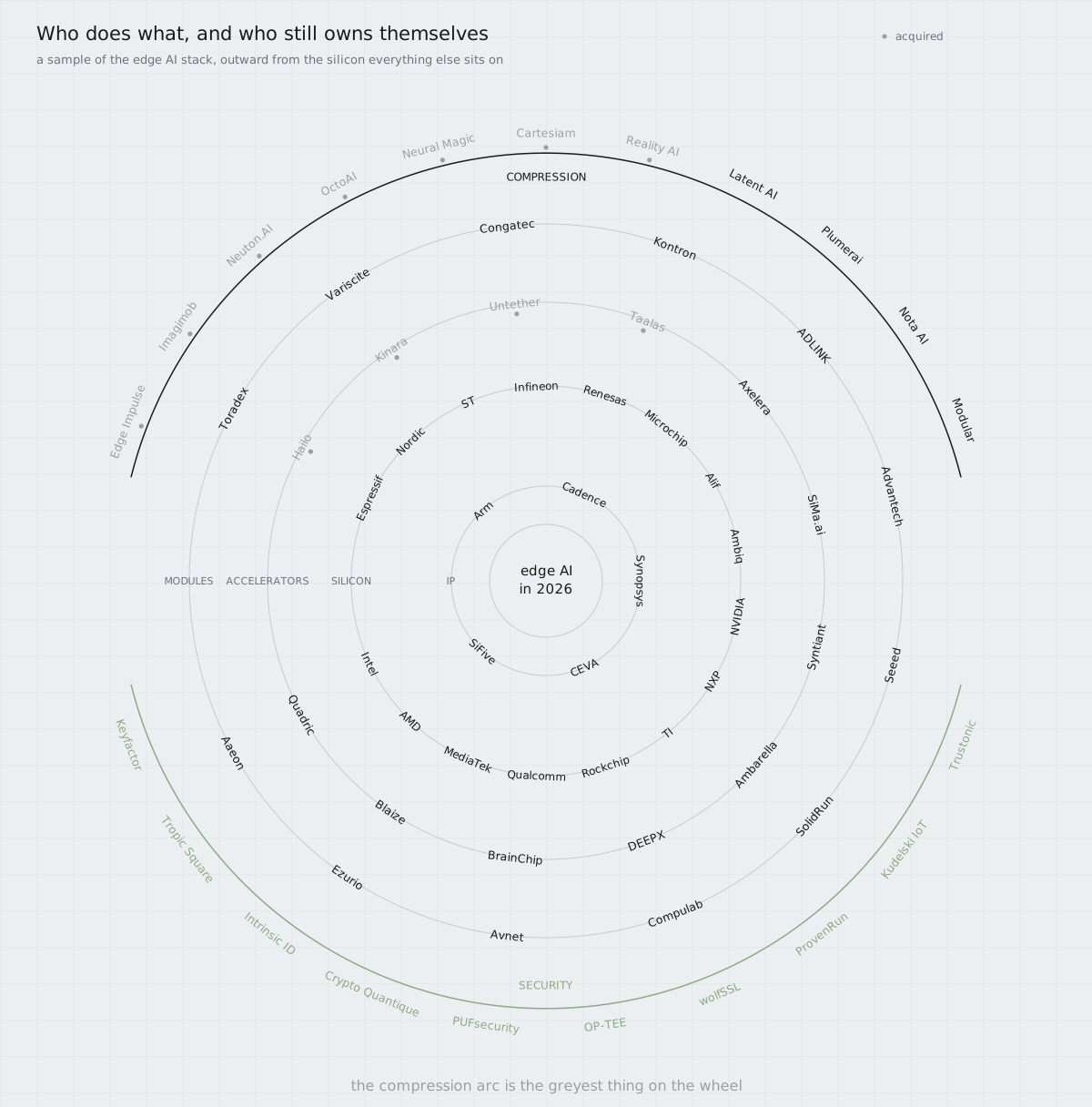
Look at the outer ring and the story is already there. The compression arc is the greyest thing on the wheel, and the security arc facing it is almost entirely intact. That is the pattern this post is about.
The first wave was the toolchain
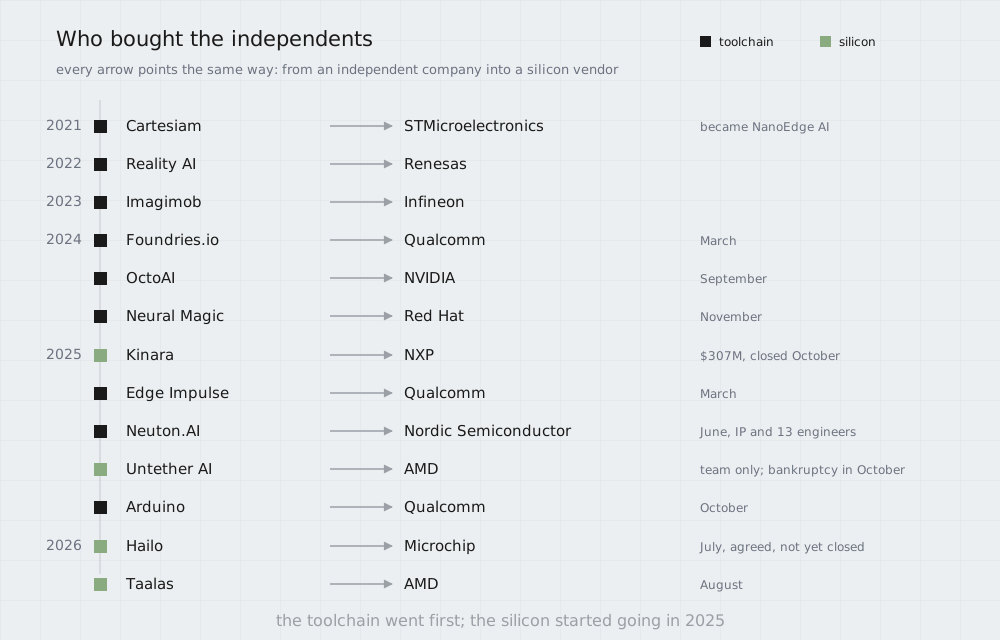
Between 2021 and 2025, most of the independent companies whose job was getting a model onto small hardware were acquired by companies that make small hardware.
STMicroelectronics took Cartesiam in 2021 and turned it into NanoEdge AI. Renesas took Reality AI in 2022. Infineon took Imagimob in 2023. Nordic took the IP, the assets and thirteen engineers out of Neuton.AI in June 2025. NVIDIA took OctoAI in September 2024, and Red Hat took Neural Magic that November, which is the one deal in the list where the buyer does not sell silicon.
Qualcomm did it three times. Foundries.io in March 2024, Edge Impulse in March 2025, and then Arduino in October 2025, arriving with a board built on its own Dragonwing silicon. Buying Arduino is not really a hardware purchase. It is a purchase of the place where a few million people learn what an embedded device is.
The logic is sound from where the buyers sit. A chip is worth more when it is easy to deploy on, the tooling is cheaper to buy than to build, and every acquisition removes a company that was helping customers evaluate competing parts. What it does to the rest of us is narrow the field of tools that will honestly tell you another vendor’s chip is the better fit.
The second wave is the silicon itself
The part I did not expect is that this stopped being a software story around 2025.
NXP bought Kinara for $307 million in an all-cash deal that closed in October 2025. AMD took Untether AI’s engineering team in 2025 and Untether filed for bankruptcy that October. AMD bought Taalas in August 2026. And in July 2026 Microchip signed a definitive agreement for Hailo, the best funded independent NPU company in the field, which had been valued at $1.2 billion in early 2024 and whose SPAC had collapsed at under half that. Terms were not disclosed. As I write this the deal has not closed; it is expected to at the end of September.
So the independent accelerator tier is going the same way the independent tooling tier went, on a four year delay and with worse outcomes for the founders. Being the horizontal player in this market, the one who works across everybody’s chips, turns out to be a position you occupy on your way to somewhere else.
What this costs you, concretely
None of this is villainy. It is what consolidation looks like in a market where the margin lives in silicon and the software is a feature that sells it. But if you are choosing a stack this year, it changes the calculation in three ways.
The tool you standardise on today may belong to a competitor’s silicon vendor next year. That does not mean it stops working. It means its roadmap stops being neutral, the support for the parts you actually use gets thinner, and the benchmark comparing your chip favourably against the new owner’s quietly disappears.
Portability is no longer a free default, it is a thing you pay for. Every acquisition adds gravity toward one vendor’s runtime. If you want to keep the option of moving from an NXP part to a Renesas one, that option now has an owner and a price.
And the survivors are priced by the same logic. When a company with Hailo’s funding ends up selling on undisclosed terms, everyone still independent is negotiating in that shadow.
The overlap nobody is in
There is one more thing in the data, and it is the part I find most interesting.
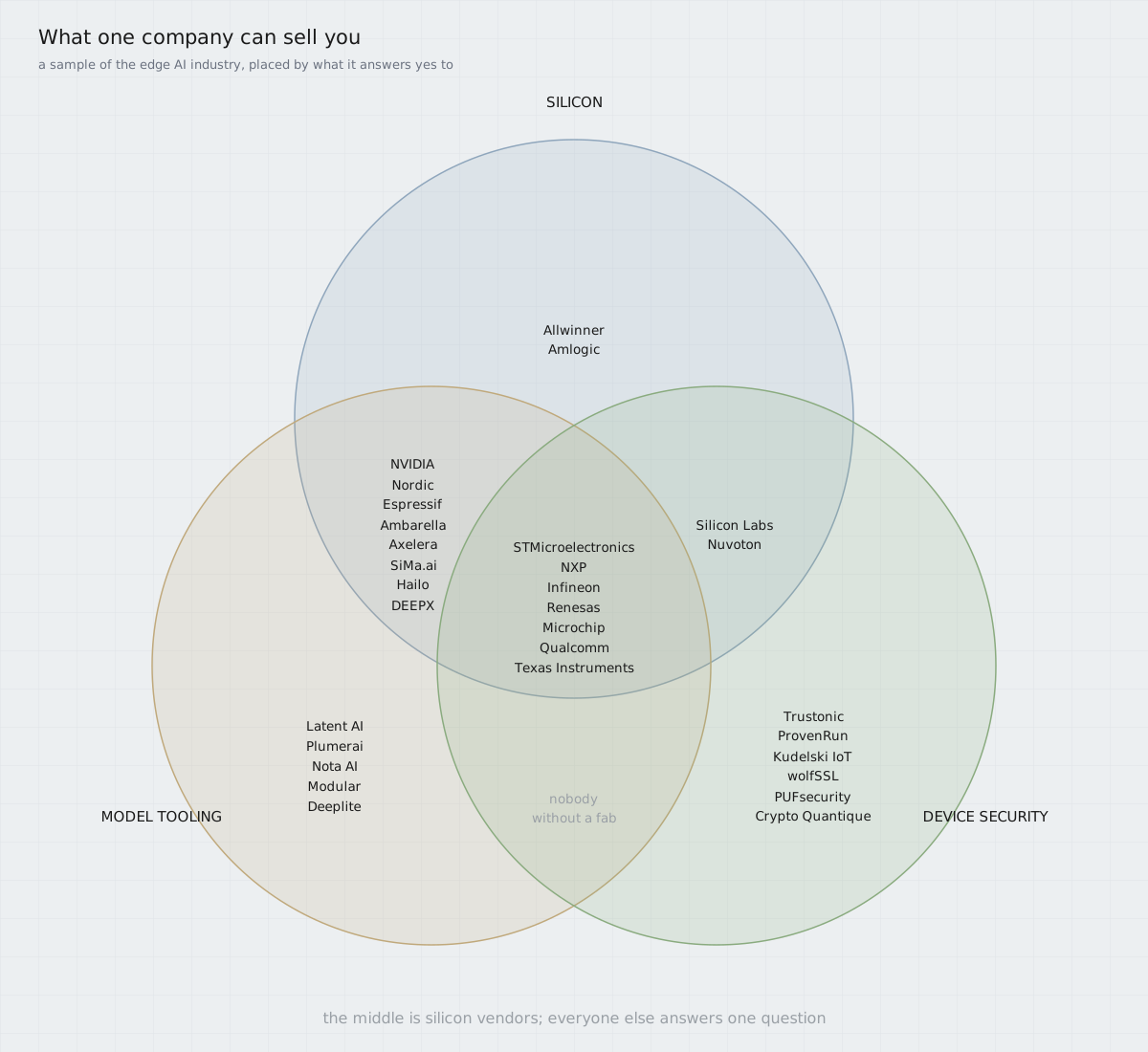
Sort the field by what a single company can actually sell you and the middle fills with exactly one kind of business. STMicroelectronics, NXP, Infineon, Renesas, Microchip, Qualcomm and Texas Instruments make the chip, ship the toolchain and sell the secure element. They bought the second of those in the last five years and have been selling the third for twenty.
Almost everyone else answers one question. And the region where model tooling meets device security, with no fab underneath, has nothing in it.
That gap is fine right up until you ship. A model compressed onto a €27 part is sitting in a device an attacker can buy, put on a bench and read. The compression vendor’s answer is that security is not their layer. The security vendor’s answer is that they secure the boot chain and the keys, and what you run inside is your problem. Both are correct, and the space between those two answers is where a shipping product actually lives.
There is one place that gap is already closed, and it is the middle of that diagram. A chip vendor can sell you the model tooling and the secure element together, working properly, today. The price is that you buy their silicon and keep buying it.
Look at what every box on that diagram is actually selling, though, and it is a component. A chip, a toolchain, a secure element, a module. Turning those into something that detects the thing you care about, fits a part you can afford and cannot be lifted off the board is left to you, and that assembly is most of the work. The wildfire detector in the last post needed a model written from scratch, a resolution change, a colour change and a rewritten convolution kernel before it ran at all. None of that came out of a box, and no toolchain would have done it for me.
I should be straight that this is our reading and we have a stake in it. Kernwerk sells the finished detector rather than the tooling to build one: the model, the port onto the part you can afford, and the seal that keeps it yours, as a single deliverable. That is a position on the market this post describes, so read the argument as one we are motivated to make. The acquisition table above is checkable either way, and it does not depend on believing us.
What I would watch
Three things would tell you whether this pattern holds or breaks.
Whether the Hailo deal closes on schedule at the end of September, and whether anything about the terms becomes public. Whether the handful of names still alone in the tooling circle raise, sell or quietly stop, since that list is short now. And whether a chip vendor buys into the security circle, because a silicon vendor acquiring a model protection company would be the first real change in the shape of this market rather than more of the same.
The map is dated. Everything above is as of September 2026, and in this market that is a shorter shelf life than it sounds.
That is the work we do. We build the detector, get it onto the part you can afford to ship, and seal it so it stays yours. One thing that works, whoever ends up owning your toolchain. Talk to us.